


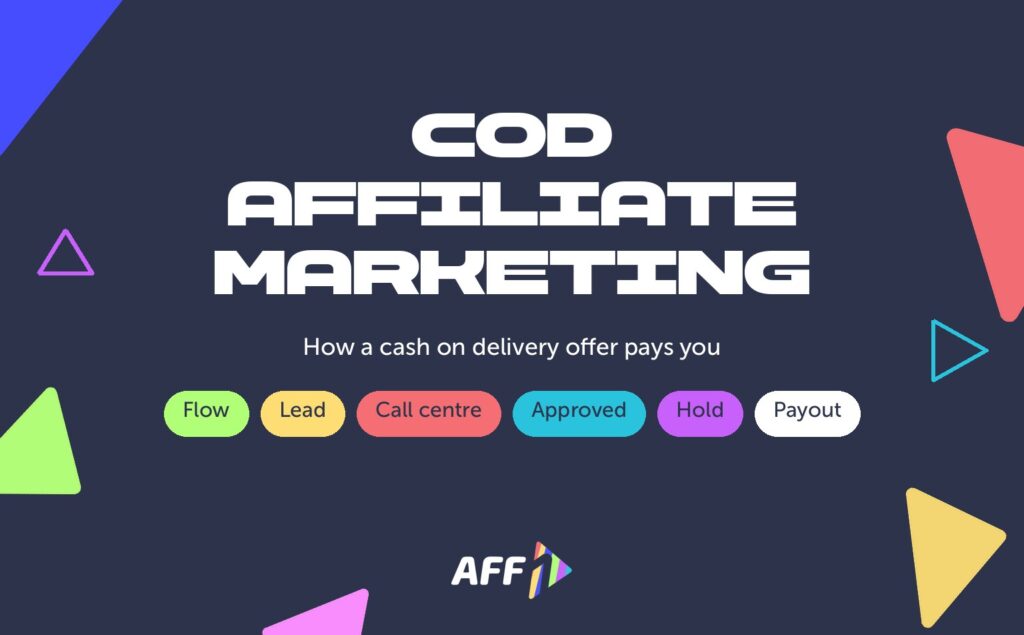
COD affiliate marketing is promoting cash on delivery offers: you send paid traffic to a landing page, the buyer leaves a name and phone number, a call centre confirms the order, and the parcel is paid at the door. The affiliate is paid a fixed amount for every order the call centre approves.
This guide follows one order through the whole chain. You will see who is responsible for each step, when your payout is earned and when you can withdraw it, which numbers on an offer page decide whether a campaign can work, and what to set up before the first click.
What is COD affiliate marketing?
COD, or cash on delivery, is a way of paying for a product when it arrives: the buyer pays the courier, not a website. COD affiliate marketing is the affiliate side of this model. An advertiser sells a product with payment on delivery, and affiliates bring buyers through ads on the traffic sources the offer allows.
Most COD offers are paid on a CPA basis, and the action is a confirmed order. A filled-in form is not enough, because many forms never turn into a real purchase. On AFF1 the paid goal is called Approved order plus the country code, for example Approved order PH for the Philippines.
The model is common in nutra — health and wellness products — and in markets where many shoppers prefer to see the product before paying or do not use cards online.
Who does what in a COD offer
Several parties share the work, and your results depend on all of them. Knowing where your part ends helps you read the statistics correctly.
| Party | What they do | What the affiliate controls |
|---|---|---|
| Affiliate (media buyer) | Buys traffic, chooses the pre-landing and landing, sets up tracking | Ads, targeting, GEO, time of day, an honest message |
| Affiliate network | Gives access to offers, counts leads, sends postbacks, pays out | Which network and offer you choose |
| Advertiser | Owns the product, sets the price and the payout, runs delivery | Nothing directly; you read the offer terms |
| Call centre | Calls buyers to confirm the order, product, price and address | Indirectly: clear ads give the operator an easier call |
| Courier | Delivers the parcel and collects the money | Nothing directly |
AFF1 is a direct advertiser and an affiliate network in Nutra & White Hat. It processes orders in its own call centres, so lead statuses come straight from its operators.
How a COD order moves from click to payout
- Click. A person sees your ad and follows your flow link — the tracking link AFF1 gives you, which sends visitors to the pre-lander and landing you picked.
- Order form. The visitor enters a name and phone number on the landing page. The network records a new lead.
- Confirmation call. An operator calls the buyer during the call centre’s working hours and checks the order details.
- Final status. The lead becomes approved, cancelled or trash. Each status is explained in COD lead statuses.
- Hold. The payout for an approved lead is credited to your hold and moves to your balance when the goal’s hold period ends.
- Delivery. The advertiser ships the parcel, and the buyer pays the courier. This is the buyout stage.
- Withdrawal. You request a payout from your balance. AFF1 processes payouts within 4 days.
Steps 3 and 6 happen without you, but your ads still shape them. Ads that match the product and the price usually mean easier calls, more confirmed orders and fewer refused parcels.
When does the affiliate earn and when can you withdraw?
There are two different moments, and new affiliates often mix them up.
- Earned — when the call centre approves the order. On an offer paid per approved order, this is the event that creates your payout.
- Withdrawable — when the goal’s hold period is over and the money is on your balance. Then you can request a payout.
Delivery comes later still and is on the advertiser side. On an offer paid per approved order, the parcel being collected does not add to your payout. Delivery quality still matters: if parcels from one source are often refused at the door, the advertiser loses money and may review how it works with that source. Treat a low buyout as a signal about your traffic, not as somebody else’s problem.
What to check on a COD offer before you launch
Every AFF1 offer page shows the terms you need. The help article How to connect to an offer describes each field. Read them in this order:
- Goal — what exactly is paid, for example Approved order for one country.
- Payout — the amount per approved order for each country.
- Landing price — the price the buyer sees. Your ads must not show a different one.
- Hold — how long the payout waits before it reaches your balance.
- CC working hours — when the call centre calls buyers. Leads that arrive outside these hours are called once the call centre is working again.
- Conversion types — COD for cash on delivery.
- Traffic sources — allowed sources are ticked green, forbidden ones are marked red.
- Rules — approaches the advertiser does not accept. Breaking them can cost you the payout.
Some offers are available only on request. In that case the page shows Request access: describe your experience, traffic source and planned budget in the ticket, and your manager will answer there.
The numbers that decide if a COD campaign works
In COD you pay for clicks and leads, but you are paid only for approved orders. So the key number is not the cost per lead but the cost per approved order. The basic arithmetic:
| Metric | Formula | What it tells you |
|---|---|---|
| Approval rate | approved ÷ leads with a final status | How many of your leads become paid orders |
| Cost per approved order | ad spend ÷ approved orders | Your real cost of one paid action |
| Revenue | approved orders × payout | What you earn before ad spend |
| Break-even CPL | payout × approval rate | The highest cost per lead at which payouts still cover ad spend |
Count the approval rate only on leads that already have a final status. New leads at the end of the day are still waiting for a call and make the rate look lower than it is.
Approval rates by offer and GEO: AFF1 data
The same offer can have a very different approval rate in different countries. Here is what the AFF1 leaflet shows for four offers in seven GEOs:
| GEO | Joints | Blood sugar | Heart | Prostate |
|---|---|---|---|---|
| Philippines | 36% | 37% | 29% | 34% |
| Ghana | 24% | 26% | 22% | 25% |
| Peru | 26% | 28% | 25% | 22% |
| Hungary | 42% | 45% | 40% | 35% |
| Greece | 31% | 33% | 26% | 29% |
| Italy | 34% | 38% | 36% | 28% |
| Spain | 34% | 34% | 33% | 30% |
Source: AFF1 leaflet, 2026. Approval rate by offer and country; the leaflet does not state the period or the number of leads.
Take the break-even formula from the table above. With the same payout, a joints offer in Hungary (42%) can absorb a cost per lead 1.75 times higher than the same offer in Ghana (24%). Before you launch, take the payout and the approval rate for your country and calculate your maximum CPL. If your traffic source cannot deliver leads below it, choose another GEO or another source.
What to set up before the first click
A few settings take minutes and save you from lost leads and wrong reports.
- Flow with a click ID. In the flow link window, turn on the Use clickid for external tracker integration checkbox and add the click ID macro of your tracker (in Keitaro it is
{subid}, in Binom{clickid}). AFF1 returns it to the tracker through the{clickid}token in the postback URL. - Data parameters. Use
data1–data4in the flow link to see campaign, ad set and creative in AFF1 statistics. - Postback. Send creating, confirming and cancelling lead events to your tracker, so it counts approved orders instead of forms. Setup: Postback: send leads and statuses to your tracker.
- Traffic back. Visitors from countries the offer does not accept, or traffic that arrives while the offer is paused, can be redirected to another URL instead of being lost. Setup: Traffic back and other flow settings.
- Ad schedule. Compare your ad hours with the call centre working hours of the goal. Buying most of your traffic when nobody can call the buyer can lower your approval rate.
Common mistakes with COD offers
- Judging an offer by its leads, not its approved orders. A cheap lead is worth nothing if it is never confirmed.
- Promising what the product is not. Health claims and miracle results break ad platform policies and usually the offer rules, and they can lead to refusals on the call. Describe the product honestly.
- Mixing GEOs in one campaign. The call centre serves the countries of the goal. Clicks from other countries are wasted without traffic back.
- Sending test orders to a live offer. They are likely to be marked as trash and spoil your statistics. If you need to test the chain, agree on it with your manager.
- Scaling before the data is in. Wait until enough leads have a final status and the cost per approved order is below the payout, then raise the budget. More on this in scaling advertising campaigns.
FAQ
Is COD affiliate marketing the same as dropshipping?
No. A dropshipper owns the store, sets the price and handles orders, deliveries and returns, often through a fulfilment service. A COD affiliate only brings buyers to the advertiser’s landing page. The advertiser runs the call centre, the stock and the delivery, and the affiliate is paid a fixed amount for each approved order.
Do I get paid if the buyer refuses the parcel?
On an offer paid per approved order, the payout is tied to the order the call centre confirmed, not to the moment the courier collects the money. Refused parcels still cost the advertiser money, and the advertiser may review how it works with a source that has many of them. Rules for refused parcels can differ by offer, so check the offer terms and ask your manager.
How fast do COD offers pay out?
There are two steps. First, the payout for an approved order waits in hold; the hold period is shown next to the payout on the offer page. When it ends, the money moves to your balance and you can request a payout. On AFF1 payouts are processed within 4 days.
Do I need a tracker to run COD offers?
Not necessarily: your AFF1 account shows every lead and its status. A tracker becomes useful when you run several campaigns or sources and need to see which ad brings approved orders. Connect it through the click ID in the flow link and a postback, so the tracker receives statuses, not only form submissions.
Which traffic sources work for COD offers?
It depends on the offer. Each AFF1 offer page marks which traffic sources are allowed and which are forbidden. Check the list and the offer rules before you create a flow, and follow the advertising policies of the platform you use. Traffic from a forbidden source breaks the offer terms.
Start with a COD offer
Cash on delivery rewards affiliates who bring real buyers: an honest message, the right country and ads that run while the call centre is working. AFF1 has been creating its own offers since 2018 and processes orders in its own call centres.
Sign up with AFF1 and compare payouts, hold periods and call centre hours across GEOs. Questions about a specific offer? Write to us on Telegram: t.me/aff1com.


Comments
No comments yet. Ask a question about the article and the AFF1 team will answer. Comments appear after moderation.